Support Guide
Grief Literacy: A Guide for Australian Women
April 2026 · 20 min read · Free resource
Written by Aana Carpenter, Counsellor
Published April 2026 · Updated 28 August 2026
Contents
- Content warning and a note before you begin
- 1. What grief literacy is, and why it matters for women
- 2. The landscape of loss: what actually counts as grief
- 3. How grief actually works: what contemporary models say
- 4. How grief can show up in the body
- 5. The cultural pressure women face around grief
- 6. Practical self-care during grief
- 7. When and how to seek professional support
- 8. A short note from Aana
- 9. Resources
- Help-seeking strip
A resource from Safe Refuge Counselling, a private online and in-person counselling practice for women based in Mount Barker, South Australia. Safe Refuge Counselling is not a domestic violence service. This guide is written by Aana Carpenter — ACA Registered Counsellor, Level 1.
Content warning and a note before you begin
This guide discusses loss in many forms: bereavement, perinatal loss, estrangement, illness, the ending of relationships, and other losses that tend to be overlooked. There is no graphic detail about traumatic death, and no description of methods of self-harm. Still, reading about grief can bring grief closer. If you are inside a fresh wave of loss, or if today is a hard day, please feel free to skim, skip, or close this page and come back later. Your pacing is the right pacing.
If at any point you need to talk to someone now, scroll to the bottom for Australian helplines. You do not have to wait until things feel worse.
If you are deciding whether individual support might suit you, the grief counselling service page explains what sessions involve, the limits of the service, and how to begin. The shorter article on signs grief counselling may help is another place to start.
1. What grief literacy is, and why it matters for women
Grief literacy is a relatively new phrase for a very old human need. Researchers at Curtin University, led by Professor Lauren Breen, have defined grief literacy as "the capacity to access, process, and use knowledge regarding the experience of loss." It is a multidimensional skillset. It includes emotional competence (recognising what grief feels like from the inside), relational competence (knowing how to offer and receive support), and cultural competence (understanding that grief is shaped by community, faith, gender, and circumstance).
Grief literacy is not about performing wellness. It is about having enough shared language and shared understanding that a person in the middle of a loss is not left to invent her own vocabulary alone.
Why does this matter particularly for women in Australia?
Because women tend to carry the emotional labour of loss for entire families. When a parent dies, it is often a daughter who coordinates the funeral, holds the grieving siblings, writes the eulogy, cleans the house, and then quietly returns to full-time work while being asked how her father is holding up. When a baby is lost before birth, it is the mother whose body carries both the physical and the emotional aftermath, often with very little community acknowledgement. When a marriage ends, women are more likely to be told to "move on" than to be invited to mourn. When a friendship dissolves, there is almost no cultural language for the grief that follows.
A 2024 Australian health literacy and inclusivity review of bereavement resources in healthcare settings found that the existing print materials given to grieving families scored poorly on both understandability and actionability. The mean PEMAT score for understandability was 61.5 percent. The mean score for actionability was only 35 percent. Readability sat at a grade 10.7 reading level, well above the recommended grade 8, and cultural relevance for Aboriginal and Torres Strait Islander people and for culturally and linguistically diverse communities was minimal. In short, the resources we hand to grieving people in Australia are not reaching most of them.
This guide tries, in a small way, to close some of that gap.
You do not need to read it in order. You do not need to read it all. Take what is useful. Leave what is not.
2. The landscape of loss: what actually counts as grief
One of the quiet harms women experience around loss is the sense that their grief does not "qualify." We are good at recognising death. We are less good at recognising the hundred other ways a life can be restructured by loss.
Grief can arise from any of the following, and this list is not exhaustive.
Death of a loved one. The death of a parent, partner, child, sibling, close friend, grandparent, chosen family member. Death from illness, from accident, from suicide, from age. Each carries its own texture.
Miscarriage and perinatal loss. Miscarriage, stillbirth, neonatal death, termination for medical reasons, the loss of a pregnancy that only you knew about. Perinatal loss sits at the intersection of bereavement and reproductive grief, and in Australia it is still too often met with "at least it was early" rather than "I am so sorry." Red Nose Grief and Loss offers specialist Australian support for these losses.
Infertility and reproductive loss. The grief of cycles that do not work, of a diagnosis that changes the shape of a future, of bodies that do not do what women were told they would do.
Divorce and the ending of long relationships. The death of a shared life, shared home, shared rituals. Grief for the partner you loved at twenty-two who is no longer the person across the kitchen table. Grief for the marriage you had hoped to have.
Friendship endings. The slow drift, the sudden fracture, the friendship that quietly did not survive a change in life stage. Friendship grief is almost entirely disenfranchised. There are no cards for it.
Estrangement. From a parent, a sibling, an adult child. Estrangement is sometimes the healthiest choice available, and it is almost always grieved.
Empty nest. When children leave home, or stop needing you in the way you were needed before. This grief is often dismissed as sentimental. It is not. It is a genuine restructuring of identity.
Identity loss. The self you were before a diagnosis, before motherhood, before immigration, before burnout. Matrescence (the psychological transition into motherhood) is itself a form of identity grief.
Career loss. Redundancy, forced early retirement, the end of a profession that shaped you, the career you stepped away from for caregiving.
Health loss. Chronic illness, disability, the loss of functions you once had. Grief for the body you had at thirty. Grief for the stamina you used to take for granted.
Pet loss. The death of an animal companion is a real bereavement. Dismissing it as "just a pet" is itself a form of disenfranchised grief.
Climate and ecological grief. Also known as solastalgia. The grief women feel about the state of the world they are raising children into. Researchers in Australia have taken this form of grief seriously for more than a decade.
Ambiguous loss. A term coined by American researcher Pauline Boss. Ambiguous loss describes grief when the lost person is physically absent but psychologically present (for example, a missing person), or physically present but psychologically absent (for example, a loved one with advanced dementia). Ambiguous loss is particularly hard because there is no funeral, no social script, no closure.
Disenfranchised grief. A term from American sociologist Kenneth Doka. Disenfranchised grief is grief that is not openly acknowledged, socially sanctioned, or publicly mourned. Miscarriage, estrangement, pet loss, the death of an ex-partner, grief within marginalised communities, and friendship endings all frequently sit in this category.
If your grief is on this list, or if it is on a list you would add yourself, it counts.
3. How grief actually works: what contemporary models say
Most Australians have heard of the five stages of grief. Denial, anger, bargaining, depression, acceptance. This framework was introduced by Swiss-American psychiatrist Elisabeth Kubler-Ross in 1969. She developed it from her work with terminally ill patients, and it was originally a description of how dying people respond to their own impending death. It was never intended as a universal map of bereavement.
The stage model endures because it is tidy, and because grief is not. But clinicians and researchers moved past it decades ago. A few contemporary models are more useful and more honest.
The dual process model (Stroebe and Schut, 1999)
Dutch researchers Margaret Stroebe and Henk Schut proposed that grieving people oscillate between two states. One state is loss-orientation: crying, remembering, feeling the absence, processing the pain. The other state is restoration-orientation: getting the groceries, doing the school run, functioning at work, figuring out how to live a restructured life.
Healthy grieving moves back and forth between these two states. Some days are loss-heavy. Some days are restoration-heavy. Both are grief. Neither means you are doing grief wrong. Women who feel guilty for laughing two weeks after a death, or for sobbing in the car park six months on, are usually in the middle of a perfectly normal oscillation.
Continuing bonds (Klass, Silverman, and Nickman, 1996)
The older model of grief assumed that the "work" of mourning was to detach from the person who had died. Contemporary research rejects this. Continuing bonds theory holds that people can, and often do, maintain an ongoing internal relationship with the person they have lost, and that this can be healthy. Talking to a mother who has died, keeping a ritual on an anniversary, feeling a loved one's presence in a particular song, asking "what would she have said about this?" These are not pathological. They are often integrative.
Worden's tasks of mourning (Worden, 1982 onwards)
American psychologist J. William Worden offered an alternative to stages: four tasks that a grieving person works through, often not in order, often circling back.
- To accept the reality of the loss.
- To process the pain of grief.
- To adjust to a world without the deceased person (or, more broadly, without the thing or relationship that has been lost).
- To find an enduring connection with what has been lost while embarking on a new life.
Worden's language of tasks is sometimes more useful than stages because it is active. It acknowledges that grief asks something of you, over time, without dictating a schedule.
What this means practically
Grief is not linear. It is not a tunnel with a light at the end. It is more like a tide that comes in and out over a long coastline. Some tides are gentle. Some are storm surges. Plans for Christmas, a song in the supermarket, the smell of someone's jumper, a due date that never arrived, an anniversary you were not expecting to feel, all of these can bring the tide back up without warning. This is not regression. This is how grief behaves.
4. How grief can show up in the body
Grief is not only emotional. It can affect sleep, appetite, energy, concentration, and the way the body feels from one day to the next. Healthdirect's Australian grief and loss guidance describes physical and behavioural responses alongside emotions, while also stressing that experiences vary.
Some experiences people report during grief include:
- Sleep changes. Difficulty falling asleep, waking early, vivid dreams, or sleeping more than usual.
- Appetite changes. Either loss of appetite or an increase. Food may taste different. Some women describe feeling nauseated around food for weeks.
- Fatigue. Tiredness and reduced capacity for ordinary tasks.
- Difficulty concentrating. Forgetfulness, losing the thread of conversations, or finding decisions harder than usual.
- Physical tension or discomfort. Some people notice headaches, muscle tension, digestive upset, or a feeling of heaviness.
- Tears at odd moments, or an absence of tears when you expected them. Both are normal.
These experiences can occur during grief, but grief should not be used to explain away new, severe, or persistent physical symptoms. Tell your GP that you are bereaved or going through significant loss and ask for medical advice about symptoms that concern you. For chest pain, difficulty breathing, collapse, or another medical emergency, call 000.
5. The cultural pressure women face around grief
If grief is hard, grieving as a woman in Australia adds particular weight.
The emotional labourer role. Women are often positioned, inside families and workplaces, as the people who manage everyone else's feelings. When loss enters a family, women are expected to organise, inform, comfort, plan the wake, bring the food, write the thank you cards, check on the grandparents, and hold the children. Very little space is left over for her own grief, which is often postponed indefinitely.
The expectation of quick recovery. Under Australia’s National Employment Standards, an employee can take two days of compassionate leave for each permissible occasion. That statutory entitlement is not a timetable for grief, yet people often return to work while the effects of loss are still very present.
The performance of being "fine." There is a specific social pressure on women to reassure others that they are coping. "I'm doing okay, thanks for asking." "We're getting through." "Mum would have wanted us to keep going." These phrases are often true. They are also often the only acceptable script. The woman underneath the script may be drowning.
The silencing of losses that do not fit neat categories. Miscarriages get condolence cards less often than funerals. Estrangements do not get condolence cards at all. Divorce after a long marriage can be met with "it must be a relief." Friendship endings have no ritual. When a loss is not recognised, the grief has nowhere to go.
The intersection with caregiving. Many women are grieving while still caregiving: for children, for ageing parents, for a partner with a chronic illness. Grief and caregiving are not mutually exclusive. They are often simultaneous, and the exhaustion compounds.
The intersection with identity. For women whose identity has been shaped by motherhood, partnership, career, faith, culture, or all of these at once, a loss that ruptures one strand can feel like a loss of self. This is real. It is not melodrama.
Naming these pressures is not complaint. It is orientation. If the room you are grieving in has gravity pulling against you, it helps to know that the gravity is there.
6. Practical self-care during grief
Nothing in this section will make grief stop. That is not what self-care during grief is for. The aim is to give your body, your mind, and your spirit just enough scaffolding to move through the season without collapsing under the weight of it.
Routine, loosely held. Grief dissolves structure. A light daily rhythm helps: something to get up for, something to eat, something to move, something to rest. Not a schedule. A shape.
Nourishment. Eat something, even if it is small, even if you do not want to. Warm, simple, familiar foods. Soup. Toast with butter. Rice. A cup of tea. If cooking is beyond you, frozen meals, takeaway, or food delivered by a friend are completely acceptable solutions for as long as they need to be.
Gentle movement. Walking outside, if you can, for even ten minutes. A slow stretch in the morning. Swimming. Not as exercise, as regulation. Movement helps the body metabolise grief in ways that sitting still does not.
Hydration and caution with substances. Grief and alcohol are not friends. A glass of wine numbs briefly, disrupts sleep deeply, and amplifies the wave the next day. Caffeine, while understandable, can worsen the anxiety and sleep disruption that often accompany grief. Notice what you are reaching for, without shame.
Ritual. Humans have used ritual for grief across every culture and every century. Light a candle. Visit a place that held meaning. Write a letter you will not send. Cook a recipe that was hers. Plant something. Revisit photographs on an anniversary. Ritual gives grief somewhere to sit.
Contact, in small doses. Grief is isolating, and isolation worsens grief. Even brief contact with a trusted friend, one phone call, one walk, one shared meal a week, is protective.
Permission to not be okay. You do not owe anyone a performance of resilience. Saying "I am not okay today, and that is what today is" is allowed. So is saying "I actually feel alright today, and I am going to let that be true" without guilt.
Permission to keep joy. Laughing does not betray the person or thing you have lost. Joy during grief is not a failure of love. It is evidence of life continuing.
Lower the bar. Whatever you thought you should be doing this week, halve it. Then halve it again. Grief is work. It is not visible work, but it is work. Your capacity for everything else is temporarily reduced. That is appropriate.
7. When and how to seek professional support
Many people move through grief with time, community, ritual, and rest. Professional support is not a requirement or a measure of how serious a loss was. It can be useful when you want a private place to talk, when grief continues to dominate daily functioning, or when it coexists with concerns that need clinical or medical care.
Signs it may be useful to seek additional support
Diagnosing clinicians may assess for conditions that can coexist with or follow bereavement, including depression and prolonged grief disorder. As a counsellor, I do not diagnose. What I can offer is a plain-language list of signs that suggest talking to a professional might be useful. These are signs, not labels. Healthdirect also explains when to seek help for grief and loss.
- The intensity of the grief does not ease at all over many months and continues to dominate daily functioning.
- You feel unable to accept the reality of the loss, even after a long time.
- You feel that life has no meaning or purpose without what has been lost, and that sense does not soften.
- Intense avoidance of reminders (places, photographs, people) is narrowing your life.
- You are preoccupied with the lost person or thing to the point that it is hard to engage with anything else.
- Sleep has not recovered, or has significantly worsened, over many months.
- You are relying on alcohol, other substances, food, or overwork to avoid the grief.
- You are noticing thoughts of not wanting to be here, or thoughts of self-harm. Please reach out immediately if this is present. Lifeline 13 11 14 is available any time.
Grief and depression can overlap
Grief and depression can share experiences such as sadness, changes in sleep or appetite, low energy, and difficulty concentrating. Grief often remains closely connected to a loss, but there is no simple checklist that can reliably separate the two for every person.
The two can coexist. If you are unsure, or low mood is persistent and affecting everyday life, a conversation with your GP or a diagnosing mental health practitioner is the right next step. I can walk alongside you in that conversation; I cannot make the diagnosis.
What a grief counselling session looks like
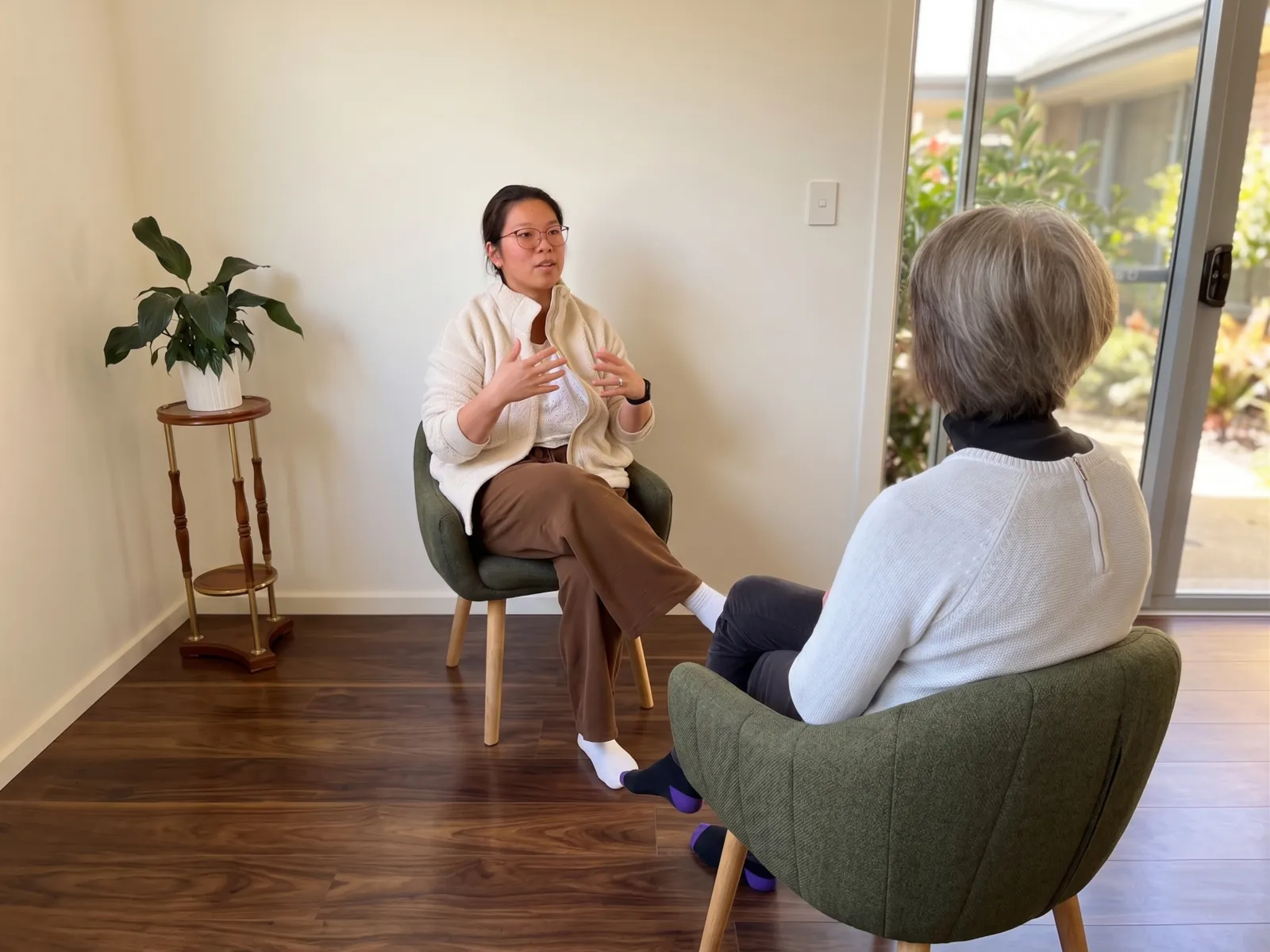
Grief counselling with me at Safe Refuge Counselling is usually a conversation. Fifty minutes, online via secure video or in person at Mount Barker, South Australia. No couch, no pathologising, no homework you cannot manage. The first session is a gentle orientation. We talk about what you have lost, when, how, and what the loss has asked of you since. You do not need to have it all organised. Tears are welcome. So is silence. So is practical problem-solving if that is what the week needs.
Over time, a grief counselling relationship can help you:
- Give language to what you are carrying.
- Make space for feelings that other parts of your life do not have room for.
- Work through specific stuck points (complicated goodbyes, unresolved guilt, anger at someone who has died, the reshaping of identity after a loss).
- Build rituals and continuing bonds that feel right for you.
- Notice how your body is carrying the grief and what it might need.
- Navigate practical decisions (anniversaries, family dynamics, work disclosure, parenting through your own grief).
Scope of what a counsellor can do
I am Aana Carpenter — ACA Registered Counsellor, Level 1. Within that scope, I can support, help with, work through, explore, navigate, guide, and provide psychoeducation. I cannot diagnose, prescribe, or deliver clinical treatment for disorders. If what is happening for you needs diagnosis or medication, I will help you think about who to talk to and I will keep walking alongside you as part of a wider team.
No GP referral or Mental Health Treatment Plan is needed to book. Sessions at Safe Refuge are not Medicare-rebatable. See the current fees and Medicare information, or read about grief counselling in Mount Barker and online.
8. A short note from Aana
This work matters to me for reasons I cannot separate from my own life.
I am a Singaporean-Australian woman, a mother, and a practising Catholic. I have known loss in my family and in my own body. I have sat with women for whom grief was the unspoken centre of the room for years before they could name it.
What I hope for the women who arrive in my practice is simple. I hope they find a space where their grief, in all its shapes, is allowed to take up room. I hope they leave their first session understanding that they are not broken, that they are not too much, and that what they are carrying has a name. I hope they move, in their own time, not past what they have lost, but into a life that carries it with them.
If you are reading this because a loss has found you, I am so sorry. And I am glad you are here.
9. Resources
Australian grief organisations
- Healthdirect. Australian-government-funded information about grief responses and when to seek professional help. Grief and loss
- Grief Australia (formerly the Australian Centre for Grief and Bereavement). National education, research, and counselling referral. grief.org.au
- Griefline. National grief support and resources. 1300 845 745. griefline.org.au
- Red Nose Grief and Loss. Support for miscarriage, stillbirth, newborn death, and the death of a child. 24-hour support line 1300 308 307. rednose.org.au
- Bears of Hope. Pregnancy and infant loss support. bearsofhope.org.au
- The Compassionate Friends Australia. Peer support for families bereaved by the death of a child of any age. compassionatefriendsvictoria.org.au
- StandBy Support After Suicide. 1300 727 247. standbysupport.com.au
- CanTeen. Support for young people affected by cancer and bereavement. canteen.org.au
- Palliative Care Australia. Bereavement resources connected to end-of-life care. palliativecare.org.au
Reading recommendations
- It's OK That You're Not OK, by Megan Devine. A clear, warm corrective to the tidy stage model of grief.
- Bearing the Unbearable, by Joanne Cacciatore. Written by a researcher and clinician who lost her own child, particularly attentive to perinatal loss.
- A Good Death, by Margaret Rice. An Australian journalist's compassionate guide to end-of-life conversations and the grief that follows.
- The Wild Edge of Sorrow, by Francis Weller. For readers drawn to the more contemplative and ritual side of grief.
- On Grief and Grieving, by Elisabeth Kubler-Ross and David Kessler. Her later, less rigid return to the topic, more useful than her 1969 work alone.
Academic references worth knowing (for readers who find comfort in the research)
- Breen, L. J., Kawashima, D., Joy, K., Cadell, S., Roth, D., Chow, A., & Macdonald, M. E. (2022). Grief literacy: A call to action for compassionate communities. Death Studies.
- Stroebe, M., & Schut, H. (1999). The dual process model of coping with bereavement.
- Worden, J. W. (2018, 5th ed.). Grief Counseling and Grief Therapy.
- Klass, D., Silverman, P. R., & Nickman, S. L. (Eds.). (1996). Continuing Bonds.
- Bartley et al. (2024). Health literacy and inclusivity review of bereavement resources available in an Australian healthcare setting. Health Literacy and Communication Open.
Help-seeking strip
If you need to talk to someone now, you do not have to wait:
- Lifeline 13 11 14 (24/7)
- Beyond Blue 1300 22 4636 (24/7)
- GriefLine 1300 845 745
- PANDA (perinatal anxiety and depression) 1300 726 306
- 13YARN (First Nations crisis support) 13 92 76
- 1800RESPECT 1800 737 732
In an emergency, call 000.
To explore support with Aana, read about grief counselling at Safe Refuge or book a free discovery call. Safe Refuge Counselling is a private counselling practice for women, offered online nationally and in person from Mount Barker, South Australia.
Take the Next Step
Ready to Begin?
A discovery call is a short, free conversation to explore whether Safe Refuge is the right next step for you.
Book Now