What trauma-informed counselling actually looks like in a session
March 2025 · 8 min read
Written by Aana Carpenter, Counsellor
Published March 2025 · Updated 28 August 2026
Table of Contents
"Trauma-informed" has become one of the most overused phrases in mental health. It appears in yoga studio advertising, in corporate wellness brochures, and on counselling websites that never define what it means in practice. If you have had a first therapy experience that left you feeling exposed, rushed, or quietly judged, the word may have lost its meaning for you entirely.
This post is for the woman who is considering trying again. It explains, in concrete terms, what a trauma-informed counsellor actually does in a session, and how it differs from the generic talk therapy you may have encountered before.
I am Aana, the counsellor at Safe Refuge Counselling, a private online and in-person counselling practice for women. It is not a domestic violence service, despite what the name can suggest at first reading. I work with women navigating trauma, grief, perinatal distress, and the quieter forms of struggle that do not always have a clinical name. When I describe my practice as trauma-informed, I am not using shorthand. I am committing to six specific principles that shape every moment of contact I have with a client.
The six principles, translated into what you would notice
The six principles of trauma-informed care are drawn from the work of the US Substance Abuse and Mental Health Services Administration (SAMHSA) and have been adopted widely across Australian mental health settings. They are safety, trustworthiness and transparency, peer support, collaboration and mutuality, empowerment and choice, and cultural, historical and gender awareness. For Australian information about the different ways trauma can affect people, see Phoenix Australia, the national centre for posttraumatic mental health and Healthdirect's overview of PTSD.
Here is what each one looks like in a session.
1. Safety
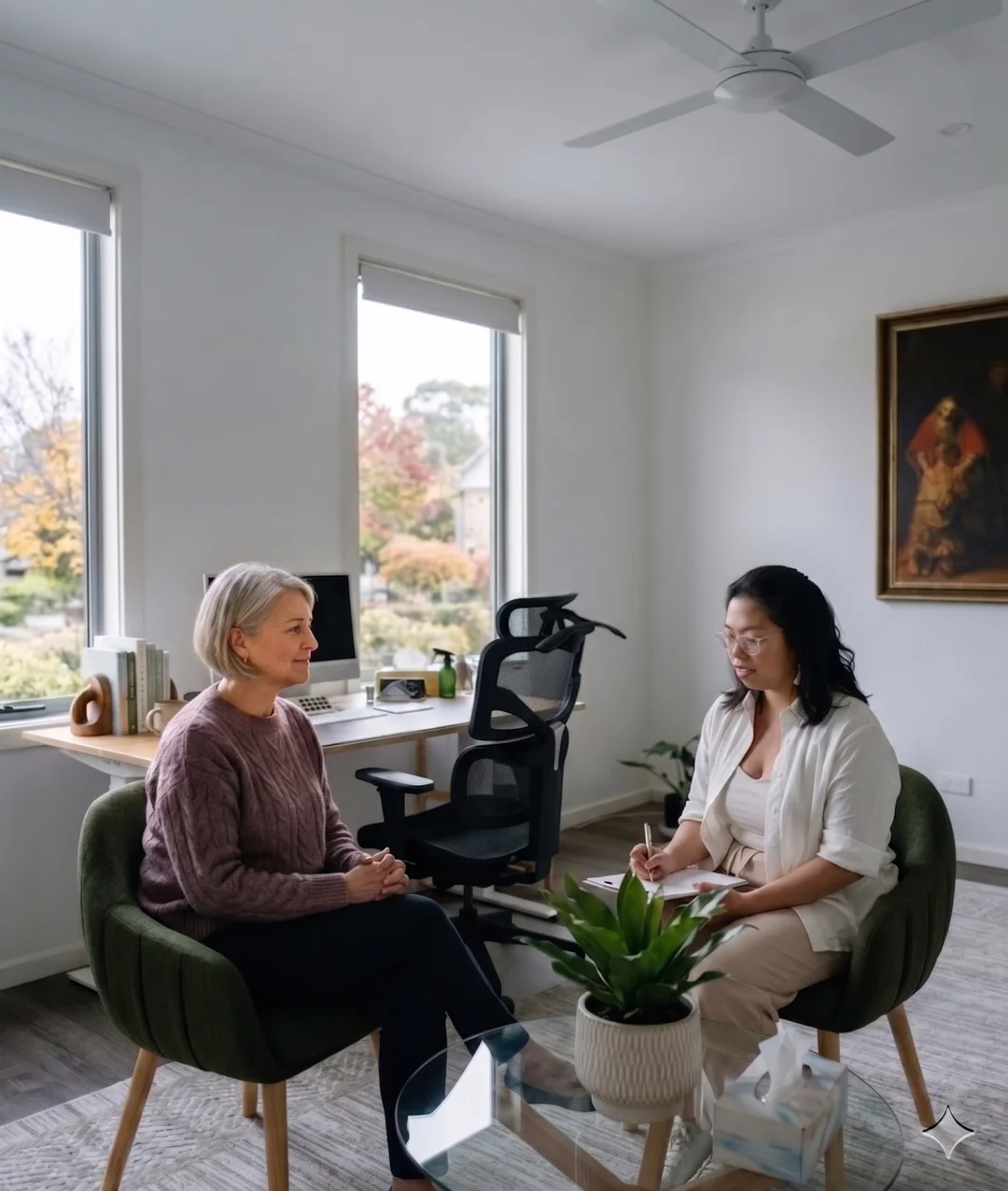
Safety is the first principle because nothing useful happens without it. In a session, safety means the room (or the screen) feels calm and contained, not clinical or cold. It means I ask before I move closer to difficult material, rather than pushing you into it. It means the first session is often slower than you expect, because we are establishing that you can pause, change the topic, or say "not today" without losing ground.
If you are new to counselling, you might notice that I name things out loud that other therapists leave implicit. I will tell you that you do not have to share your whole story in the first session, or ever. I will tell you that crying is welcome and so is not crying. I will tell you where the tissues are.
2. Trustworthiness and transparency
Trustworthiness is built through small, consistent acts. Starting sessions on time. Ending them on time. Being clear about fees, cancellation policy, and what I do and do not do. Following through on anything I say I will send you.
Transparency means I tell you why I am asking a particular question, rather than collecting information behind a professional mask. If I suggest we try a grounding exercise, I explain what it is and why it might help before we begin. You are never a passive recipient of technique.
3. Peer support
In a one-to-one counselling setting, peer support looks different from group work, but the principle still matters. I may point you toward peer-led communities, reading material written by other women with lived experience, or a perinatal support line if that fits your situation. The message is that you are not the only woman who has felt this way, and connection with others who understand can sit alongside the work we do together.
4. Collaboration and mutuality
In a trauma-informed session, I am not the expert on you. You are. My role is to bring counselling skills, psychoeducation, and a steady presence. Your role is to bring what you know about your own life. We set goals together, review them together, and change them when your life changes.
In practice, this means I check in about the process itself. Is the pace right? Is there something you wish we were doing differently? Have I said something that landed badly? Permission to give that feedback is built into the way we work.
5. Empowerment, voice, and choice
Empowerment is often reduced to a slogan. In the room, it looks like offering choices and meaning them. Would you like to start with what is on your mind today, or pick up from last week? Would you like to keep your eyes open or closed during this exercise? Would you prefer to work on this area, or something else first?
For women who have experienced environments where their voice was minimised, being asked genuine questions and having the answer respected can itself be a therapeutic experience.
6. Cultural, historical and gender awareness
Trauma does not happen in a vacuum. It happens in bodies that are shaped by culture, migration, gender, faith, family history, and community. A trauma-informed counsellor pays attention to these contexts without requiring you to educate her from scratch.
In my practice, this means I ask about cultural background early, I am careful not to assume what family or community mean to you, and I hold space for the complicated feelings women often carry about their own mothers, their heritage, or the places they have left behind.
How this differs from generic talk therapy
Talk therapy can be warm and useful. It can also feel unsafe when a client is asked to recount difficult experiences before enough trust, choice, and stability have been established.
Trauma-informed counselling is different in three specific ways. First, the pace responds to what you can safely manage, rather than requiring disclosure according to a fixed session structure. Second, the relationship is explicitly part of the work, not a neutral backdrop to it. Third, the purpose is not catharsis or retelling for its own sake. The intention is to work in a way that supports safety, understanding, and choice, while recognising that no session can promise a particular emotional result.
If your first therapy experience felt like you were being processed, what you are looking for may not be a different therapist with the same approach. It may be a different approach altogether.
What trauma-informed counselling does not replace
Trauma-informed describes how counselling is offered. It is not itself a diagnosis, an emergency service, or a guarantee that one approach will suit every person. A counsellor cannot diagnose PTSD or prescribe medication. If you need a formal assessment, medication review, or specialist trauma treatment, a GP, psychologist, or psychiatrist should lead that part of your care. Phoenix Australia has guidance on finding trauma support.
Safe Refuge is also not a domestic violence or sexual assault response service. If you are in immediate danger, call 000. For specialist family, domestic, or sexual violence support, contact 1800RESPECT on 1800 737 732.
If you want to understand the service before booking, read about trauma counselling for women in Mount Barker and online. The page explains scope, pacing, common questions, and when another service should lead.
If you would like to explore whether counselling with Safe Refuge might suit you, you are welcome to book a free discovery call.
If you need support now
Lifeline: 13 11 14 (24/7 crisis support)
Beyond Blue: 1300 22 4636
1800RESPECT: 1800 737 732 (sexual assault, family and domestic violence)
13YARN: 13 92 76 (for Aboriginal and Torres Strait Islander people)
PANDA: 1300 726 306 (perinatal anxiety and depression)
Take the Next Step
Ready to Begin?
A discovery call is a short, free conversation to explore whether Safe Refuge is the right next step for you.
Book Now